

A compression test measures how well each cylinder seals during the compression stroke. It’s one of the most useful diagnostic checks you can run on a motorcycle engine, because it tells you whether the mechanical foundation is sound before you spend time on fuel, spark, or carburetion.
If a bike won’t start, runs rough, has lost power, or you’re assessing a used machine before buying it, this is the test that answers the question underneath all the others. It takes about half an hour and needs one tool you probably don’t own yet.
What Compression Actually Tells You
During the compression stroke, both valves close and the piston rises, squeezing the mixture into a small space. Three things hold that pressure in: the piston rings, the valves sealing against their seats, and the head gasket. If any of them leaks, the cylinder can’t build the pressure it was designed for, and the engine loses power or fails to run.
A compression gauge measures the peak pressure each cylinder reaches while you crank it. Low readings point at one of those three sealing surfaces. Healthy readings tell you the engine’s mechanical condition is fine and the fault lies somewhere else.
What You’ll Need
- A compression gauge with the correct thread adapter for your spark plug size, commonly 10mm, 12mm, or 14mm on motorcycles
- A spark plug socket and the tools to reach it
- A way to hold the throttle wide open
- The service manual for your bike, which carries the specification you’re comparing against
Screw-in gauges work better on motorcycles than the push-in type, because plug wells on bikes are often deep and angled, and getting a consistent seal by hand is difficult.
Preparing The Engine
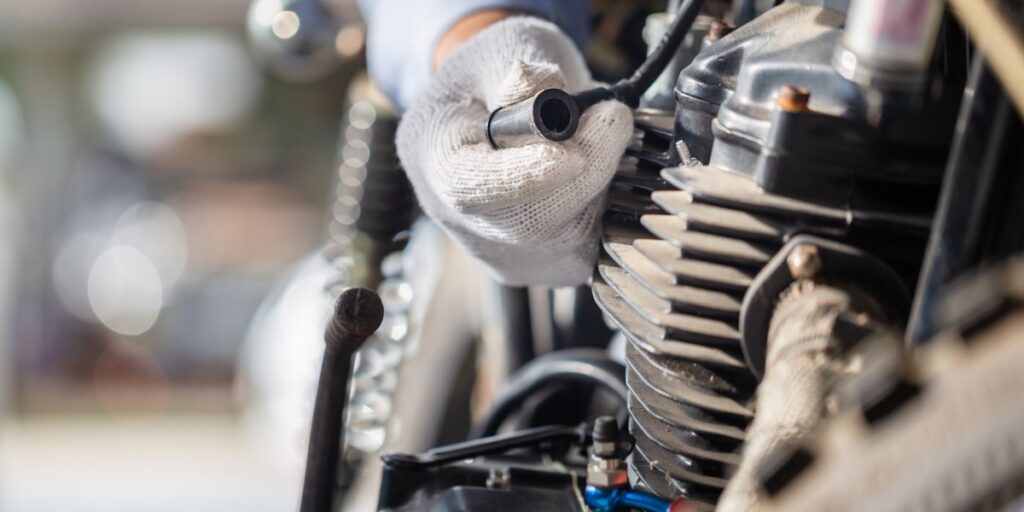
Warm the engine to operating temperature first, then shut it off. A warm engine gives readings that reflect how the bike actually runs, since clearances close up as components expand. Some manuals specify a cold test, so check yours.
Then:
- Remove all the spark plugs, not only the one for the cylinder you’re testing. This lets the engine crank at full speed, and cranking speed affects the reading directly.
- Disable the ignition system so it can’t fire while you crank. Grounding the plug leads or pulling the ignition fuse both work, and your manual will say which method suits your bike.
- Turn off the fuel or disconnect the pump on fuel-injected machines, so raw fuel isn’t pumped into the cylinders.
- Make sure the battery is fully charged. A weak battery cranks slowly and produces artificially low readings across every cylinder, which is one of the most common reasons a test gets misread.
Running The Test
Thread the gauge into the first cylinder’s plug hole, finger tight plus a light nip with a wrench if it’s the screw-in type. Hold the throttle wide open, which matters because a closed throttle restricts airflow into the cylinder and drops the reading.
Crank the engine for five to seven compression strokes, or about five seconds, and watch the needle. It should climb in steps and then settle. Note the final reading and how quickly it got there, because a cylinder that reaches its number in two strokes is behaving differently from one that crawls up over six.
Release the gauge, reset it, and repeat for every cylinder. Write down each result as you go.
Reading The Results
Compare against the specification in your manual. Figures vary widely by engine, and a healthy reading on a low-compression cruiser looks nothing like a healthy reading on a modern sportbike, so the number in the book is the only meaningful benchmark.
Two things matter:
Absolute values. Readings below the service limit indicate a sealing problem in that cylinder.
Variation between cylinders. This is often more informative than the absolute figures. Most manufacturers specify a maximum difference between cylinders, commonly around 10 to 15 percent. A multi-cylinder engine where one cylinder reads significantly lower than its neighbors has a localised problem, even if every reading technically falls within range.
The Wet Test Narrows It Down
When a cylinder reads low, the wet test tells you whether the leak is at the rings or higher up. Put a small amount of engine oil into the cylinder through the plug hole, roughly a teaspoon, then repeat the test on that cylinder.
If the reading rises noticeably, the oil has temporarily sealed worn piston rings or a worn bore, and the problem is in the bottom end. If the reading stays about the same, the leak is at the valves or the head gasket, because oil in the cylinder can’t seal either of those.
Two adjacent cylinders both reading low with no improvement on the wet test often points at a head gasket failure between them.
What Comes Next
A compression test narrows the field. A leak-down test takes it further by pressurising the cylinder with compressed air and letting you hear where it escapes: through the intake means an intake valve, through the exhaust means an exhaust valve, through the crankcase breather means rings, and bubbles in the coolant mean the head gasket. Between the two tests you’ll usually know exactly what you’re dealing with before anything comes apart.
Get The Figures For Your Engine
Specifications, service limits, permitted variation between cylinders, and whether your engine tests warm or cold all come from the manufacturer, and they differ between models and model years. At emanuals, you get OEM motorcycle repair manuals covering current bikes and machines the dealer network dropped support for years ago, drawn from a library of more than 5 million titles, and all downloads are yours to keep. Sign up for access and test your engine against the numbers it was built to!
FAQs
What is a good compression reading for a motorcycle?
It depends entirely on the engine, so use the specification in your manual as the benchmark. Variation between cylinders is often more telling than the absolute figures, and most manufacturers allow a maximum difference of roughly 10 to 15 percent.
Should the engine be warm or cold for a compression test?
Warm is standard for most motorcycles, since clearances close up at operating temperature and the readings reflect how the engine actually runs. Some manuals specify a cold test, so check yours before starting.
Why do I need to hold the throttle open during the test?
A closed throttle restricts how much air reaches the cylinder, which lowers the reading and can make a healthy engine look faulty. Wide open throttle lets the cylinder fill properly so the gauge measures sealing, not airflow restriction.
What does it mean if compression improves after adding oil?
The oil has temporarily sealed the piston rings, which means the leak is at the rings or the cylinder bore. If the reading barely changes, the problem sits at the valves or the head gasket.
Can a weak battery affect compression test results?
Yes, and it’s one of the most common causes of a misleading test. Slow cranking produces low readings across every cylinder, so charge the battery fully before you start and be suspicious of uniformly low results on a bike that runs reasonably well.